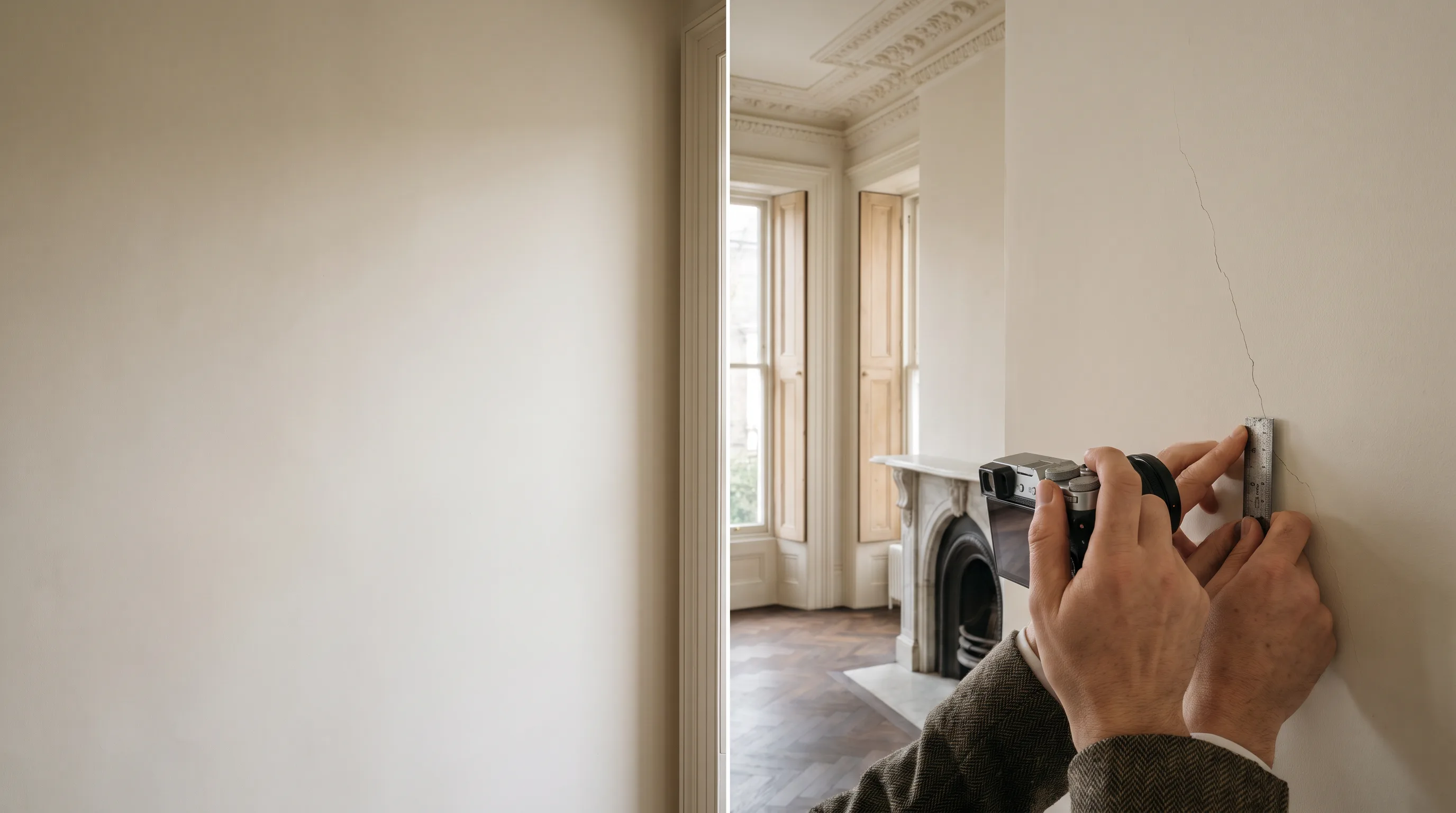
Twenty photographs and a page
A terraced house generates a lot more than twenty photographs if the inspection was thorough. Sparse coverage is not efficiency. It is gaps, and gaps favour whoever is denying the claim.
A dated photographic and written record of your property, taken before your neighbour's works begin. It is unglamorous, it takes a couple of hours, and it is the single most valuable thing the Party Wall etc. Act 1996 gives an adjoining owner. Because when a crack appears eight months later, it is the only thing that settles the argument.
Almost every disputed party wall damage claim reduces to one question: was that there before?
Without a schedule, that question has no good answer. You will say the crack is new. The contractor will say the building is Victorian and every Victorian house has cracks. Neither of you can prove it, and the party with the burden of proof is you.
With a schedule, the question answers itself. Either the defect is in the dated record or it is not. The argument stops being about memory and starts being about a document, which is exactly where an adjoining owner wants it.
A schedule of condition is only as good as the inspection behind it, and a thin one gives false comfort. You think you are protected right up until the moment you need to be.
If the schedule has already been done and you are not confident in it
The building owner, as part of the reasonable surveying costs under section 11. It is prepared for the adjoining owner's protection but funded by the person carrying out the works, because the works are for their benefit.
Before any notifiable work begins, that is the entire point. A schedule taken after the scaffolding is up and the first wall has been opened records a property that has already been exposed to the works, which materially weakens it. If your neighbour's programme is pressing, the schedule is the thing that should not be compressed.
You do not need to. A schedule of condition for an adjoining owner records your property, not theirs. Your surveyor inspects your rooms, your walls, your ceilings and the external elevations you can see. Access to the building owner's property is a separate matter dealt with under section 8.
No. A structural survey diagnoses and advises on the condition of a building. A schedule of condition simply records it, in photographs and words, at a fixed date, without opinion about cause or significance. That neutrality is what makes it useful evidence later.
That is the situation it is designed for. If a crack appears after the works that is not in the dated record taken before them, the inference is straightforward and the building owner's duty to make good under the Award is engaged. Without the schedule, you would be arguing that the crack is new against a contractor saying it always looked like that.
If your neighbour has served notice, the schedule of condition is yours by right and paid for by them. It takes a couple of hours and it is the thing you will be glad of if anything goes wrong.
No card details. No obligation. Nothing is final until you sign the appointment. A member of our office team reads every message, and a surveyor replies, usually within one working day.
What to do, and how to evidence a claim without a schedule.
Your 14 days, your three options, and how to check the notice is valid.
The binding document the schedule is annexed to.