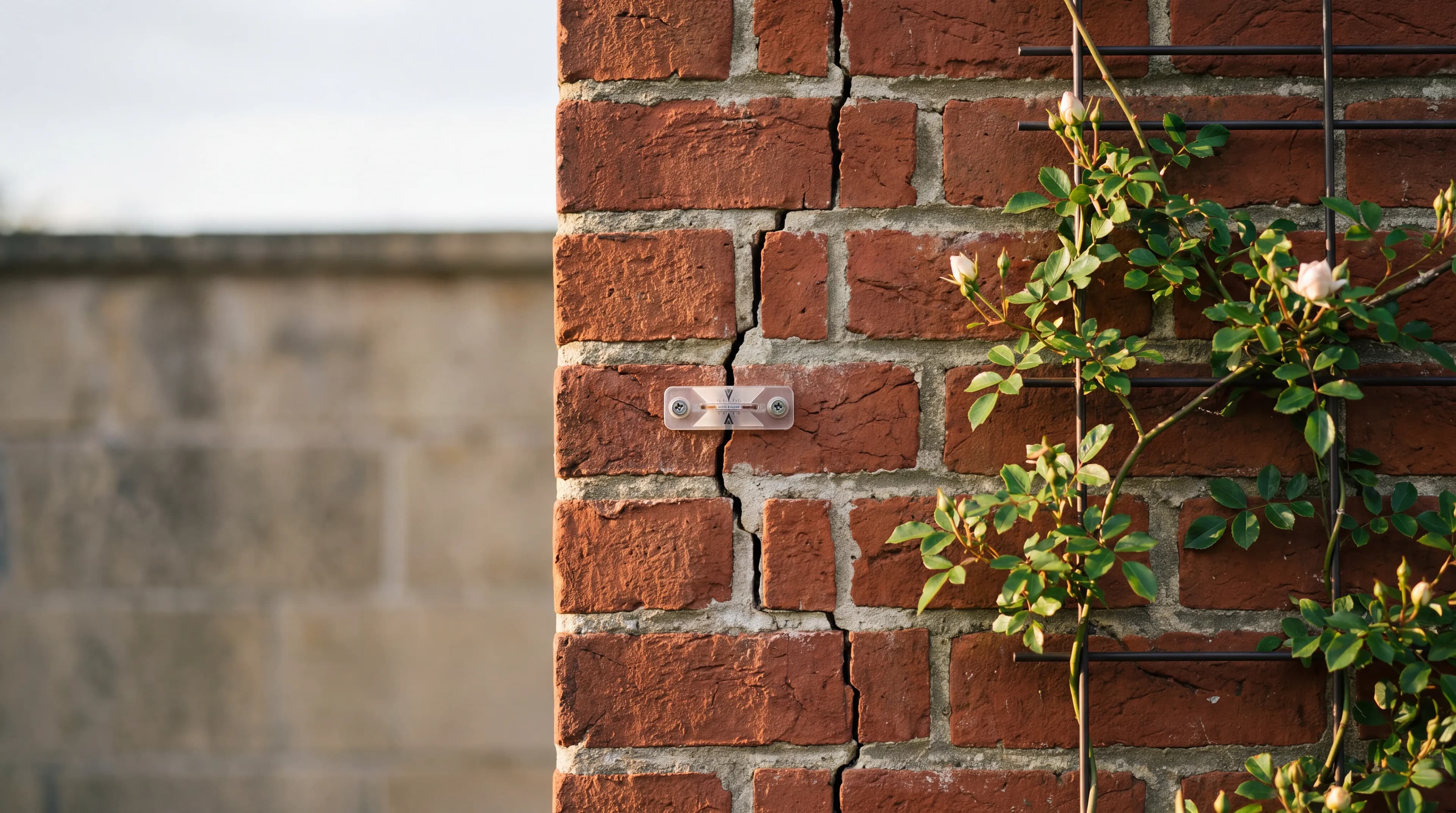
Their building work has
damaged your property.
Under the Party Wall etc. Act 1996 a building owner must compensate an adjoining owner for loss or damage resulting from the works, and must make good. That duty exists whether or not there is an Award in place. But how you enforce it, and how hard it is, depends entirely on the evidence you gather now.
Report it while the contractor is still on site. Damage raised during the works is straightforward; the same damage raised a year after completion is a materially harder case.
Evidence now. Everything else after.
The instinct is to telephone the neighbour. Spend the first hour on the evidence instead . Cracks get filled, scaffolding comes down, and site records disappear.
Photograph everything, with scale and date
TodayWide shots to establish location, then close-ups. Put a ruler or coin against each crack so the width is readable. Do not crop or edit the images. The original file metadata carries the date, and that matters.Write a dated note of what you observed and when
ContemporaneousWhen you first noticed it, what was happening next door at the time, any noise, vibration or event you associate with it. A note written on the day carries far more weight than a recollection written later.Do not let anyone repair it yet
ImportantWell-meaning offers to 'just fill that in' destroy the evidence of the mechanism. And the crack pattern is often what demonstrates the cause. Nothing should be made good until it has been recorded properly.Report it in writing
To the right peopleIf there is an Award, notify both surveyors immediately. If there is not, write to the building owner directly, briefly and without accusation, stating what you have observed and asking them to notify their contractor and insurer.Get it inspected
Before making goodA surveyor records the damage, forms a view on causation, and specifies what making good actually requires. Under an Award this is what your appointed surveyor is already there to do.
What we look for, and why the pattern matters.
Causation is the whole argument. A crack is not evidence on its own. Where it is, what shape it is and how fresh it is are what tie it to the works.
Buildings crack for many reasons, and a Victorian house that has been standing for 140 years has usually done some of it already. Distinguishing new movement from old is a surveying judgement, and it is made on characteristics rather than on assertion.
That is also why we would rather look before anything is filled. A crack that has been made good tells you very little; the same crack photographed and measured tells you a great deal.
Indicators of recent, works-related movement
- Clean, sharp arrises. A fresh crack has crisp edges and unweathered, undecorated faces. An old one is dirty, painted into, or filled.
- Position relative to the works. Damage concentrated on the elevation or rooms nearest the excavation or the party wall, tailing off with distance.
- A coherent pattern. Diagonal stepped cracking through mortar joints running back from the works, rather than isolated random cracks.
- Doors and windows binding. Openings that have started to stick, or that no longer close, indicate distortion rather than shrinkage.
- Timing. Appearance during or shortly after excavation, breaking out, piling or underpinning next door.
- Progression. A crack that has widened between two dated photographs is live movement, not historic.
- External corroboration. Movement in the drive, path, boundary wall or garden structures near an excavation, consistent with the same ground movement.
Beware the informal cash offer
What you are entitled to.
Two routes, depending on whether an Award is in place.
With an Award: the duty to make good is built into it. You report the damage to the surveyors, they inspect and determine what is required, and the building owner carries it out or pays for it. If the two surveyors disagree, the matter goes to the third surveyor for a binding determination. You do not fund any of this, and you do not need a solicitor.
Without an Award: the statutory duty under sections 2(3) and 7(2) still exists, but there is no surveyor mechanism to enforce it, so the practical route is a civil claim in nuisance or negligence which you fund and prove yourself. That is a real disadvantage. And it is the clearest possible illustration of why consenting to a notice is not the small, neighbourly gesture it appears to be.
Either way, we can act. Where an Award exists we deal with it as your appointed surveyor. Where none does, we prepare the evidence and the report you or your solicitor will need. And, frequently, resolve it by agreement without proceedings.
Damage claims, answered
Who pays to repair the damage?
The building owner. Section 2(3) and section 7(2) of the Party Wall etc. Act 1996 require a building owner to compensate an adjoining owner for loss or damage resulting from the works, and to make good. Where there is an Award in place, that duty is built into it and the surveyors determine what is required. Where there is no Award, the same outcome is usually reached through a common law claim in nuisance or negligence, but you are funding and proving it yourself.
Can I choose to be paid instead of having it repaired?
Sometimes. Section 11(8) allows an adjoining owner to require payment in lieu of making good, which can be preferable if you would rather have your own contractor do the work at a time that suits you, or if the making good would be disruptive. The election has to be made properly and at the right point, so take advice before agreeing anything with a contractor directly.
I don't have a schedule of condition. Have I lost?
No, but it is harder, and the work shifts to establishing the previous condition from other sources. Estate agent photographs, mortgage valuations, homebuyer or building survey reports, insurance records, planning application photographs, Google Street View and even family photographs with a wall in the background have all been used successfully. A surveyor can also assess whether the crack pattern, its position and its freshness are consistent with the works rather than with historic movement.
How long do I have to raise it?
Raise it immediately. Practically speaking, delay is the biggest single risk to a claim. Damage under an Award should be reported to the surveyors as soon as it appears, while the contractor is still on site and the cause is demonstrable. Legal limitation periods are longer, but a claim raised eighteen months after the scaffolding came down is a much harder claim than the same one raised the week it appeared.
The contractor says the crack was already there.
That is the standard response, and it is exactly what the schedule of condition exists to answer. If there is one, the question is settled by looking. If there is not, it becomes a matter of surveying judgement about crack characteristics, position relative to the works, and whether the mechanism is consistent. Which is a question for a surveyor rather than for the person who did the work.
Should I claim on my own insurance?
Tell your insurer, because most policies require notification, but be careful about claiming. If the damage was caused by your neighbour's works, the liability is theirs, and claiming on your own policy may cost you an excess and affect your premium for a loss you should not be bearing. Notify, explain that a third party is responsible, and take advice before making a claim.
Get the damage recorded before anyone fills it in.
Send us photographs and tell us what has been happening next door. We will tell you whether it looks works-related, what your route to remedy is, and whether you need us at all.
- The building owner normally pays your surveyor's reasonable fees
- A named surveyor on your case from start to finish
- We will tell you honestly if you do not need us
No card details. No obligation. Nothing is final until you sign the appointment. A member of our office team reads every message, and a surveyor replies, usually within one working day.
Related reading
- The schedule of condition
Why damage claims turn on it, and what to do without one.
- Excavation and ground movement
The mechanisms behind most serious party wall damage.
- The Award and making good
How the duty to make good is enforced in practice.