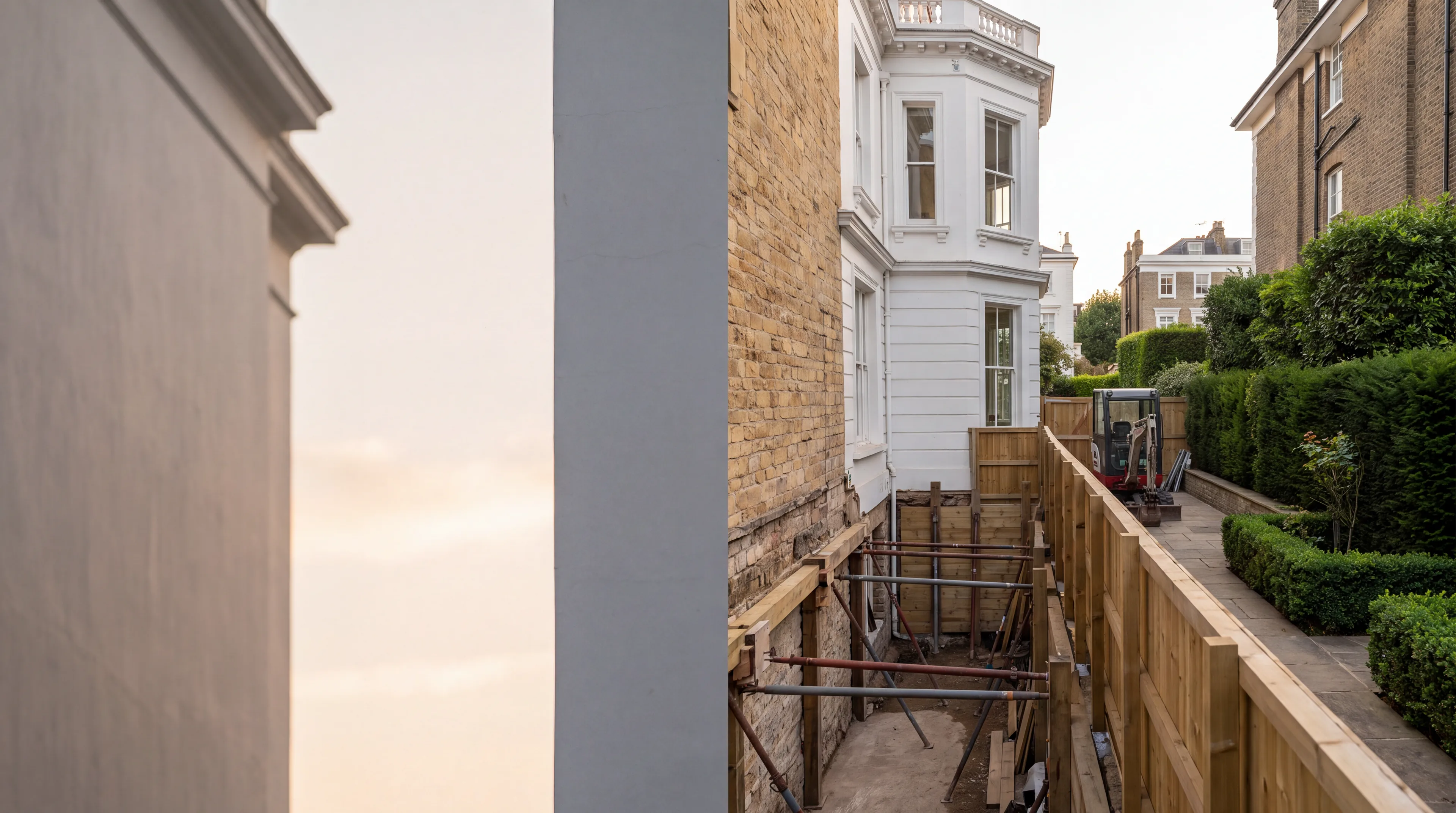
Ground relaxation
Removing lateral support lets soil move towards the excavation. Your foundation follows it. Usually small, occasionally not.
Basement excavation and deep underpinning are the highest-risk works the Party Wall etc. Act 1996 covers. Removing ground from beside a building changes how that ground supports your foundations, and the consequences show up as settlement, cracking and distortion, sometimes months after the work has finished.
If a Section 6 notice has been served on you, you have 14 days to respond. If excavation is already under way and you were never served, treat that as urgent and call us today.
With most party wall work the risk is local: a beam bearing badly, a bit of cracking around a new opening. Excavation is not local.
Your foundations rely on the ground beside and beneath them for lateral restraint and bearing. Take that ground away, even temporarily, even in bays, and the soil beneath your building will move to fill the space. On clay it may heave or shrink with moisture change. On sand it can run. On made ground it may do something else entirely. Lowering groundwater to keep an excavation dry pulls water out of soil well beyond the site boundary, and consolidation follows.
None of that means a basement next door will damage your home. Thousands are built safely every year. It means the difference between safe and unsafe lies in engineering detail, sequencing, temporary works, bay widths, dewatering, monitoring, and that detail deserves an independent professional reading it with your building in mind.
A generic Award with the word "basement" inserted is not adequate for this kind of work, and we see them.
These are the provisions we press for when acting for an adjoining owner next to an excavation. Each one exists because its absence has caused a real problem for someone.
Section 12 security for expenses is underused, and basements are exactly what it is for
Not simply because you object. The Party Wall etc. Act 1996 gives building owners the right to excavate subject to notice and to an Award, and planning permission is a separate question again. What you can do is insist the work is governed by a properly drafted Award. With monitoring, movement triggers, agreed temporary works, defined sequencing and a duty to make good. In practice a well-drafted Award constrains a basement scheme far more effectively than an objection ever would.
Section 6(1) applies where excavation is within 3 metres of your building and will go deeper than the bottom of your foundations. Section 6(2) applies within 6 metres where the excavation cuts a line drawn downwards at 45 degrees from the bottom of your foundations. Either engages the Act, and the notice must be accompanied by plans and sections showing the depth and position of the proposed excavation. Both are frequently missed on schemes that only notice the party wall itself.
Sometimes, and that is not necessarily alarming. Underpinning is a controlled, well-understood technique. What matters is the sequence, the bay widths, the pin lengths, the temporary support and the monitoring regime. Those details belong in the Award rather than being left to the contractor on the day, and getting them right is exactly what your appointed surveyor is there for.
For a basement adjacent to your property, in our view yes. Monitoring means fixed targets or levelling studs installed on your building and read at intervals through the works, so movement is measured rather than argued about. A good Award sets trigger values: at amber the contractor reviews the method, at red the works stop and the surveyors reconvene. Without triggers, monitoring is just data nobody acts on.
The building owner. Section 11 puts the cost of the works and the reasonable fees of both surveyors on them, and on a basement scheme that properly includes the extra time your surveyor spends on structural review and monitoring. A basement is precisely the case where the free protection is worth the most.
The Award can regulate working hours, deliveries, wheel washing, dust suppression and access. It cannot make a basement excavation quiet. Where nuisance goes beyond what the Award contemplates, that is a matter for the local authority's environmental health team under the Control of Pollution Act 1974 rather than for the party wall surveyors, and we will tell you where the line falls.
Send us the notice and whatever drawings you have been given. We will tell you what is actually proposed, what the risks to your property are, and what the Award needs to control, at the building owner's expense, not yours.
No card details. No obligation. Nothing is final until you sign the appointment. A member of our office team reads every message, and a surveyor replies, usually within one working day.
Evidencing a claim and the duty to make good.
Why it matters more on excavation work than anywhere else.
The 3 metre and 6 metre rules, in plain English.